10 composition styles for surface pattern designers
How to add variety to your work

Today we are taking a look at composition styles and how you can provide variety in your work by choosing different compositions for your patterns.
If you ever feel like your patterns are starting to look a little samey, or if you always default to designing the same type of pattern, working on your composition is often the key to moving fowards.
The purpose of this post is to inspire you with some new pattern ideas that you can get started on straight away. We will look together at 10 different composition styles and I'm hoping that there's one or two that you haven't tried before that may spark a new idea for you!
At the end I will explain how they can be used to help you form your own mini collection that you can add to your portfolio or share on Instagram.
What is composition?
In surface pattern design, composition refers to the way motifs are arranged within a pattern. We're not talking about whether the pattern is full drop or half drop, it's more about how the individual motifs or elements are arranged within your design.
For example the composition style for the first pattern below could be called a 'scalloped' style and the second could be called a 'symmetrical' style.


There are no official names for different composition styles, and many compositions comprise more than one style. You can see below that the composition of the pattern is both 'striped' and 'trailing'.

Why is it important to vary the composition of your patterns?
Varying the composition of your patterns is key to keeping your designs interesting and versatile. Different styles lend themselves to different uses, and each one will showcase your skills in different ways.
If you are designing in collections (which I'd really advise!) it is so important to have a number of different pattern compositions within your collection to add variety and interest.
In the next part of this post we will look at 10 different composition styles which you can use as inspiration and come back to if you are stuck for ideas.
If there are one or a few styles you haven't used before, why not give them a go? It will diversify your portfolio and help you to develop your skills.
As always I've provided lots of links to resources that will help you if you want to go further with a particular composition style.
Tossed
A tossed or scattered pattern is a go-to pattern for many designers. It is consists of evenly spaced, individual motifs across the canvas.
This composition works well if you have a particular motif in mind, say 'strawberries' and want to create a pattern featuring just this motif.
This style of composition can also be varied in a number of ways:
It can be tightly packed or spaced out. In general I tend to create tightly packed designs but I have to remind myslef, particularly in collections that I also need to create designs with more breathing space!
It can be directional or non directional. Directional prints have a very clear up and down, and non-directional prints can be viewed from any direction as motifs are placed at all different angles. Both kinds have their place but non-directional can be very helpful for sewists as the fabric can be used in any direction. It's always good to have at least one non-directional print in a collection!
It can be detailed or minimal. You can use a tossed print to illustrate very detailed motifs or use it as a simple blender print with some very minimalistic floral motifs.
If you already have my pack of pattern templates, the first template will help you to create a simple tossed pattern. As you can see below I have used this template from the pack to create a strawberry and butterfly pattern.
Scalloped
This composition style is one of my favourites and is relatively simple to achieve. You can also be very creative with it and take it in lots of different directions.
A scallop shape is a curved, tesselating shape that resembles the edge of a scallop shell. It is great for us as surface pattern designers as it provides an excellent template to help us structure a pattern.
You can pick up this scallop template for FREE here and a guide on how to use it (along with two other fun templates!)
See below how I have used a scallop template to create this block print wallpaper which I have been selling on Spoonflower for the last couple of years.

Scallops don't have to be limited to florals though! I had fun creating the boat pattern below using this same scallop template.
You can be very creative with this template shape, and it gives a great framework to start from if you are stuck for ideas.

Symmetrical
Symmetrical compositions are based on balance and mirroring, where motifs are arranged to reflect each other either vertically, horizontally, or from a central point. This creates a strong sense of harmony and flow within a pattern.
This style naturally creates a focal point, making it a great choice for hero prints within a collection. See below how I have used a symmetrical composition for the hero squirrel print in this collection.

Symmetrical patterns work particularly well for florals, folk-inspired designs, and animal motifs. While they may look complex, they are actually very approachable to create, especially when using templates or the symmetry tool in Procreate to ensure everything aligns perfectly.
If you usually work with loose, tossed patterns, trying a symmetrical composition can be a great way to challenge yourself and add variety to your portfolio.
In my beginner friendly Procreate Patterns Class I take you step by step through the creation process of a symmetrical pattern like this if you would like to go deeper with this composition style.

Checked
'Checked' is an umbrella term that covers a variety of specific print styles such as gingham, tartan, plaid and checkered.
Checks can feel classic and timeless, but they are also incredibly versatile. By changing the scale, spacing, colour palette, or line weight, you can create designs that feel traditional, modern or minimal.
Checked compositions work particularly well as supporting or blender prints alongside more organic, illustrative designs. They’re also a brilliant way to explore colour and bring out particular colours in a wider collection.
I have a couple of free tutorials to help you with specific types of checked patterns:

Striped
Striped patterns, in a similar way to checks, can be very simple to create and make great blenders for pattern collections. They can also be endlessly varied by adjusting width, spacing, direction, and colour.
They don’t have to be rigid or predictable either! Uneven, hand drawn stripes or softly textured lines can add an element of fun and playfulness to an otherwise simple concept as you can see in this hand drawn stripes tutorial.

Stripes can also pair beautifully with other composition styles. They can be overlaid with florals, combined with tossed motifs, or used as a subtle background.
You can see how in this pattern below I have combined stripes with a classic trailing floral pattern. This is a great way to bring different styles together to create something unique but you still have a rigid structure to work within.

Combining a stripe and a trailing floral is a technique I teach in my Trailing Patterns Class if you'd like to go deeper with this one.
Or if you're looking for more inspiration for stripes in general, I'd advise you checked out the entries for Spoonflower's Sophisticated Stripes Challenge. There are some really unique ideas to learn from here!
Ditsy
Ditsy compositions are another favourite of mine and a definite go-to style when I don't know what to create!
Ditsy patterns are made up of small scale, closely spaced motifs repeated across the surface. They often feel delicate and playful and are commonly used for florals.

But although florals are the norm, the style works just as well for all sorts of themes and motifs. Check out this Non Directional Ditsy Holiday Spoonflower Challenge if you want some evidence of this!
Ditsy compositions could be a hero print but also work well as a smaller scale secondary print in a wider pattern collection and are great if you'd like to create a non-directional pattern as you can easily place the motifs at all different directions.
If you have my Pattern Templates Pack there are four different ditsy templates to choose from and you can use them as the basis to illustrate your own unique motifs on the top (and you don't need to be restricted to florals!)

Mandala
Mandala compositions seem to have had a resurgence in popularity over recent years, with colouring books in particular helping to reintroduce this highly detailed, symmetrical composition style into contemporary design.
If you're not sure how to create this type of composition in Procreate it's fun and easy and I have some detailed instructions in the first part of this post.
The mandala composition can be combined with all sorts of elements or florals to create something highly decorative, or you could use a simple lined monochrome as a blender pattern within a wider collection as you can see in the bottom left pattern below.
The radial symmetry tool in procreate makes this type of pattern super easy to create in Procreate and I can guarantee once you've given it a go you won't be able to stop!

Organic
Organic compositions are loose and flowing, and often inspired by nature. Motifs are arranged in a way that feels natural rather than structured, with an emphasis on movement, irregular spacing, and soft, meandering layouts.
The three patterns below are examples of an organic layout.
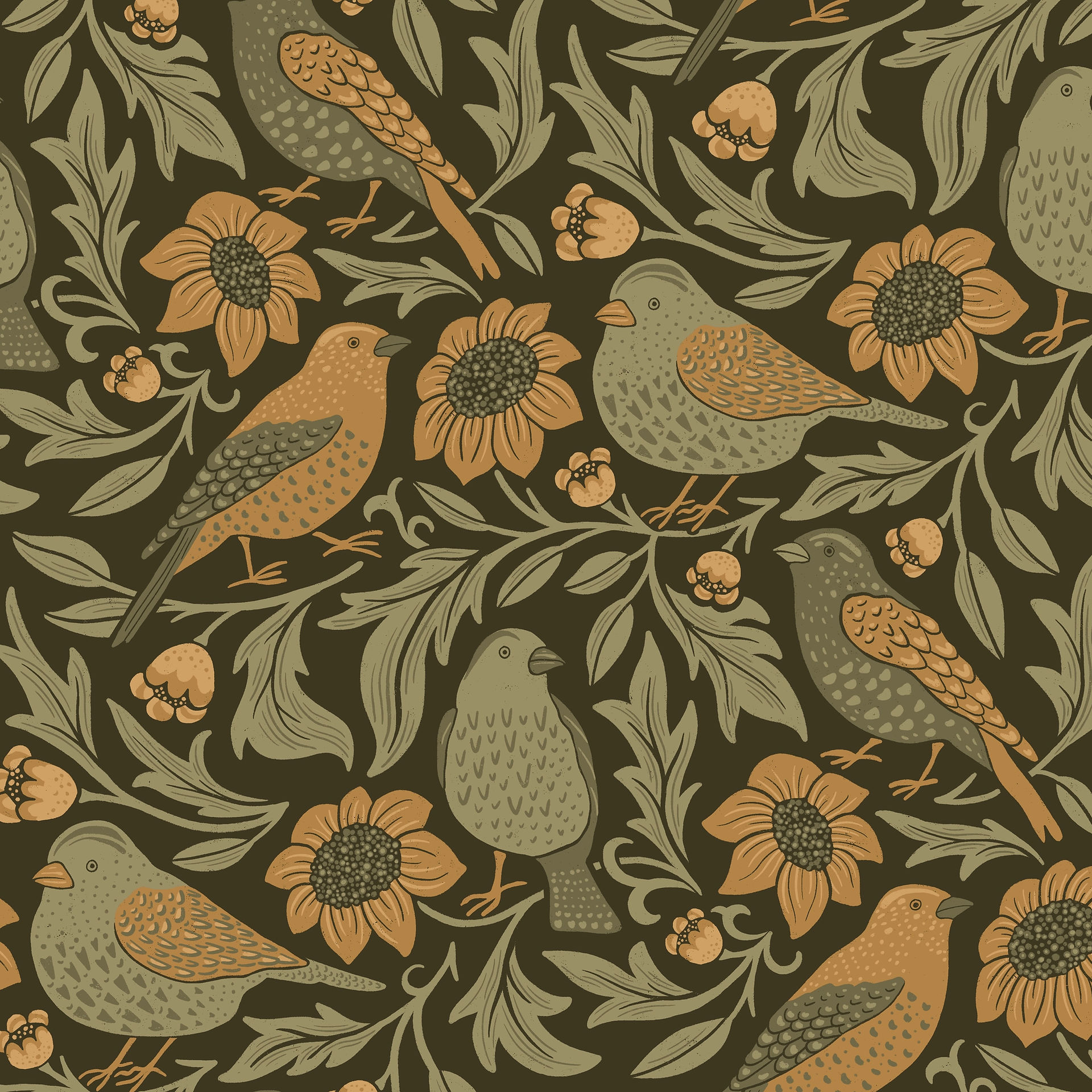


This composition style is one of the hardest to get right and often it is a case of multiple sketch layers and trial and error to get the pattern looking natural and the repeat lines hidden!
That said, organic compositions don’t need to be overly complex. The swirling floral pattern below is an example of an organic layout, as there isn’t a single obvious focal point for the eye. Instead, the pattern gently leads you through the design, and the repeat is far less noticeable than it would be in a more rigid composition such as scallops, stripes, or checks.
You can pick up this organic pattern template for free if you'd like to have a go at creating this flowing pattern yourself.

Patchwork
A patchwork composition can mean many different things but in essence it is made up of distinct blocks, of the same or varying size.
Below are three patchwork style designs I've submitted to Spoonflower challenges in the last few years.


It's a fun style to create as you can select a theme and a colour palette and just illustrate different motifs in each block!
I think the style lends itself well to paper goods such as wrapping paper, and it also allows sewists to create 'cheater quilts'.
Trailing
Trailing compositions cover a huge variety of patterns and often intersect with the organic style too with their curved and flowing stems.

Trailing desins are one of the more trickier compositions to master in Procreate but when you have got the hang of it, you can add a wonderful new dimension to your portfolio and a new layer of complexity to your patterns.
Trailing style patterns are great for many products but work particularly well for wallpaper, where the repeat becomes less noticeable and the pattern can fully unfold across a large surface.
I have a number of resources that will help you get started with trailing designs if you'd like to master this composition style:
Download this FREE trailing floral template which will have you up and running with a floral pattern in no time!
If you like the free template, my pack of 20 Pattern Templates has four more unique trailing templates that you can use to help you get to grips with the trailing technique in Procreate.
If you’re keen to master the art of creating trailing patterns from start to finish, you may want to check out my Trailing Patterns Class. In this class, we cover three unique trailing designs, and I guide you through each one step by step so you can add three new techniques to your design toolkit.

Building a mini collection
Having these composition styles handy is great for those moments when you hit a creative block and need a quick spark of inspiration.
But you could also use these composition styles to structure your own mini collection!
For example, pairing a more detailed hero print with a simpler supporting design and a subtle blender helps create balance and cohesion across a set.
Here are some trios you could try if you were thinking about building your own mini collection of three contrasting patterns:
Trio 1
Trailing (hero print)
Ditsy (supporting print)
Stripe (blender)
Trio 2
Organic (hero print)
Scalloped (supporting print)
Checked (belnder)
Sometimes having a structure like this can help you start creating when you are staring at a blank canvas and I often use these trios to form little collections to share on Instagram!
I would love to know if these composition styles have sparked any inspiration for you - do let me know in the comments below, or drop me a question and I'll get back to you!

Thank you for the informative blog Jasmine... This will help me to create patterns in a different composition style . landed your blog just on time when i got stuck with my style and all the patterns looked same.... and the suggestion for the trio patterns sounds great.. never thought like this before.. Thank You !!
This was soooo good! I loved every part of this blog post. Actually ALL of your posts are amazing! You always share so much, and genuinely care about helping other creatives. It’s so nice! I especially loved the ending of this post where you gave suggestions for trio mini collections. What a great idea! I could totally see that suggestion in a mini newsletter series, where each week for like four weeks you suggest a new trio mini collection and then have people share theirs on IG! That would be so fun! Thank you for always being so helpful and generous! ❤️
Thank you for you very informative blog. I very much look forward to exploring this on Procreate
Thank you for this very informative blog post, Jasmine! Your posts are always packed with so many wonderful examples, resource inspiration, and helpful tools! They are simply the best!! ❤️
Sincerely,
Brecken
Excellent blog post. Clear and concise and full of useful information. I’m definitely considering downloading your template pack. Although I do have quite a few templates in my collection, yours look extremely good and well put together. I love how you’ve included examples for mini collections. That is so helpful.